Vendor Insights
Verified and Third Party Tested Peptides: How to Read a COA
By Jason White · Published
Quick Answer
A peptide COA is a lab report on one specific sample. A trustworthy COA has five things: a lot number that matches the product, a named independent lab you can verify, HPLC purity plus mass spectrometry identity, the measured quantity in the vial, and endotoxin results where relevant. A 99% purity figure on its own proves very little.
Almost every peptide vendor shows "99% purity." Yet when independent groups test peptides bought online, a large share still fail basic quality checks. The gap between those two facts is why learning to read a COA matters.
This guide explains each part of a COA, what "third party tested" really means, how to check that a COA is genuine and which US labs commonly test peptides. If you are new to purity and HPLC, our guide to what peptides are covers the basics.
What Is a Certificate of Analysis (COA)?
A certificate of analysis (COA) is a document issued by a testing laboratory after it analyzes a sample. It lists the sample details, the test methods used and the result of each test.[1]
A COA describes one batch, sometimes called a lot. It does not describe a brand, a product line or every vial a company has ever sold.
COA vs certificate of conformance
A real COA shows numbers: purity percentages, measured masses, endotoxin levels. Be wary of documents that only say "acceptable," "meets standard" or "conforms" without numerical data.[2]
In house COA vs third party COA
An in house COA comes from the seller or its manufacturer. A third party COA comes from an outside lab. The difference matters because, without outside testing, the company that profits from selling the peptide is also the one certifying its quality.[3]
How to Read a Peptide COA, Section by Section
Layouts differ between labs, but most peptide COAs contain the same building blocks. The example below is illustrative only. It does not come from a real lab or product.
| Field | Example entry | What to check |
|---|---|---|
| Laboratory | Example Analytical Lab, city, state | Is it a real, independent lab you can look up? |
| Report ID | EX2026 00123 | Can you look it up on the lab's own website? |
| Sample name and lot | Peptide X, 10 mg, Lot A1234 | Does the lot match the product you are buying? |
| Date tested | October 2026 | Is it recent enough to match current stock? |
| Purity (HPLC) | 99.1% | Is a chromatogram attached? |
| Identity (MS) | Observed mass matches expected mass | Are both the expected and observed values shown? |
| Quantity | 9.6 mg per vial | How close is it to the labeled amount? |
| Endotoxin | Below limit of quantification | Was it tested at all? |
1. Header and sample information
The top of the COA identifies the lab, the report number, the test date and the sample, including the lot number. This section is what links the document to a real product. Without it, the rest of the report cannot be tied to anything you might buy.
2. HPLC purity
High performance liquid chromatography (HPLC) separates the target peptide from impurities, such as shorter or incomplete chains. Purity is usually measured with UV detection at 210 to 220 nm, where the area of the main peak relative to the total area of all peaks gives the purity figure.[4]
When a chromatogram is attached, look for three things:
- One clearly dominant main peak.
- Small, few impurity peaks.
- A purity number that matches what the chart shows.
3. Mass spectrometry (identity)
HPLC tells you how pure the sample is. It does not prove which molecule it is. Mass spectrometry (MS) measures the molecule's mass and compares it with the expected value for that peptide.
The two tests answer different questions: HPLC shows how much of the sample is your peptide, and MS shows that it is your peptide.[5] A COA with only one of the two leaves a gap.[6]
4. Quantity and net peptide content
Purity and quantity are not the same thing. A freeze dried peptide powder also contains water, salts and leftover solvents. Net peptide content is the share of the powder's weight that is actually peptide, and it is typically 70% to 90%.[7]
A worked example from a peptide manufacturer shows why this matters. A vial with a gross weight of 10 mg, 97% purity and 40% peptide content holds only 4 mg of actual peptide.[8] Some COAs report the measured milligrams per vial directly, which is easier to compare with the label.
5. Endotoxin and sterility
Endotoxins are fragments of bacteria that can trigger fever and inflammation. The standard method for injectable drug products is USP chapter 85, the Bacterial Endotoxins Test.[9]
These tests are usually optional extras. Endotoxin, sterility and heavy metal panels are typically ordered separately, so a clean purity result says nothing about contaminants that were never tested.[6]
6. Counterions, water and solvents
After synthesis and HPLC purification, peptides are usually present as trifluoroacetate (TFA) salts.[10] Some COAs report TFA, water or residual solvents. These details explain why net content is lower than purity and are a sign of a more thorough report.
Why 99% Purity Is Not Enough
The purity figure is the number most vendors highlight. It is also the number least likely to reveal a problem.
A 2026 analysis looked at public testing data on research peptides from 203 companies, covering 14 compounds tested between December 2024 and April 2026.[11] Its findings show where failures actually happen:
- Purity was rarely the issue. The median HPLC purity across all samples was 99.8%.[11]
- Quantity often was. Using thresholds similar to compounded medicines, only 58.4% of samples met both the purity and quantity criteria. The main reason for failure was the amount of peptide, not purity.[11]
- Some vials held the wrong compound. 10% of TB-500 samples and 9.1% of CJC-1295 samples did not contain the stated peptide.[11]
- Purity did not predict endotoxin. In the samples tested for it, purity had no meaningful link to endotoxin levels.[11]
The study has limits. It is a preprint that has not been peer reviewed, and the authors note that the data are not a random or representative sample of the market.[11] Still, the pattern is clear: a high purity figure alone cannot tell you whether a product is what it claims to be.
| Usually highlighted | More often the real problem |
|---|---|
| HPLC purity of 98% to 99% | Quantity far from the labeled amount |
| A clean looking chromatogram | No mass spectrometry, so identity is unconfirmed |
| "Third party tested" badge | No lot number linking the report to the product |
| A professional PDF | No endotoxin or sterility testing at all |
What "Third Party Tested" Really Means
Who sent the sample matters
There are three common models, and they are not equally strong.
- Vendor submitted. The seller sends a sample to an outside lab. This is better than no testing, but the supplier chooses which sample to send, which tests to pay for and which reports to publish.[6]
- Buyer submitted. A customer sends a sample from a product they bought. This shows what reached a real customer.
- Blind purchase. A testing group buys products anonymously through normal channels. Finnrick, for example, usually buys products itself rather than accepting samples directly from vendors.[12]
One sample, one date, one batch
A single report shows that one sample passed one set of tests on one date.[6] It does not certify the company. Testing one vial from a larger order says nothing certain about the rest of the batch.[13] The strongest setup is routine testing of finished production lots, not one sample reused for months.[6]
What lab accreditation means
The main quality standard for testing labs is ISO/IEC 17025. It sets requirements for the competence, impartiality and consistent operation of laboratories.[14]
Two details are often misunderstood. First, ISO writes the standard but does not accredit labs itself. Independent accreditation bodies do that.[15] Second, accreditation covers a specific list of methods, not everything a lab does. A lab's claim is strongest when you can find it, with its scope, in the directory of a recognized accreditation body such as A2LA or ANAB.
US Labs That Commonly Test Peptides
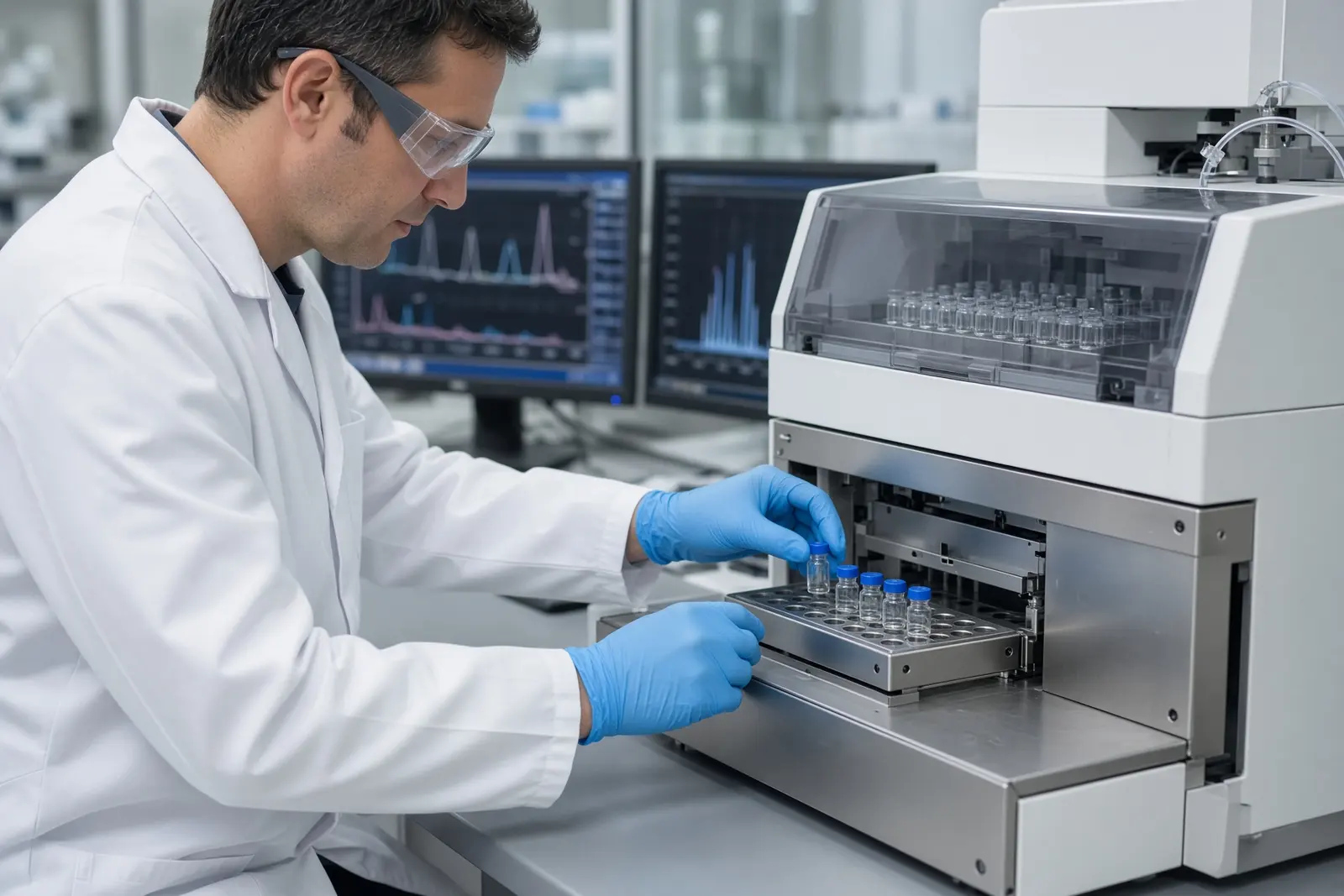
The labs below are frequently named on peptide COAs and in independent testing guides. The details come from published lab information and third party guides as of November 2026. This list is for reference only. It is not a ranking or an endorsement, and SN Peptide has no commercial relationship with any of these labs.
| Lab | Location | Published accreditation | Notable tests | Report verification |
|---|---|---|---|---|
| Vanguard Laboratory | Olympia, Washington | ISO/IEC 17025:2017 through A2LA | Purity, quantity, endotoxin, sterility, heavy metals, TFA | QR code and public lookup |
| ILS Laboratories | San Diego, California | ISO 17025 (body not named in guides) | HPLC purity and quantity, endotoxin, sterility screen, heavy metals | QR code |
| Freedom Diagnostics | Franklin, Tennessee | None published | Purity with mass spectrometry identity on the same report | Accession number lookup |
| MZ Biolabs | Tucson, Arizona | No accreditation body named | HPLC and mass spectrometry panels | Not clearly described |
| Colmaric Analyticals | St. Petersburg, Florida | Not stated | HPLC purity, mass spectrometry identity | Not clearly described |
Notes on each lab
- Vanguard Laboratory states it is ISO/IEC 17025:2017 accredited through A2LA, with HPLC methods validated to USP chapter 1225. It sells tests individually, including endotoxin, sterility and heavy metals.[13] On SN Peptide, AminoX Labs lists Vanguard among the labs it uses.
- ILS Laboratories offers a standard panel of HPLC purity and quantity, endotoxin by USP chapter 85, a rapid sterility screen and heavy metals by ICP-MS. It mainly serves clinics and manufacturers rather than individuals.[13]
- Freedom Diagnostics issues purity results only together with a mass spectrometry identity check on the same certificate. It has operated since 2023 and does not publish an accreditation.[13] On SN Peptide, Direct Vision Labs, Lumera Labs and GenPeptide name Freedom Diagnostics on their testing information.
- MZ Biolabs offers HPLC and mass spectrometry panels and is set up mainly for vendors and businesses.[16]
- Colmaric Analyticals is a contract research organization that offers HPLC purity and mass spectrometry identity, and accepts samples from individual researchers as well as vendors.[16]
Two other names you will often see
Janoshik Analytical is based in the Czech Republic, not the US, but its reports appear on many peptide COAs. Its certificates carry a code or QR for online verification, and it publishes no accreditation.[13]
Finnrick is a US testing platform rather than a single lab. It buys samples, sends them to partner labs and publishes results by vendor. It offers free testing of consumer samples for US residents.[13]
How to judge any lab on a COA
- Can you find the lab's website, address and contact details?
- Does the lab offer a way to verify individual reports?
- If it claims accreditation, can you find it in the accreditation body's directory, with a scope that covers peptide testing?
- Does the COA include both HPLC and mass spectrometry?
Lab details change over time, so confirm methods, accreditation and verification directly with each lab before relying on a report.
How to Verify a COA in Five Steps
A professional looking PDF proves nothing on its own. A PDF is easy to edit, so the report identifier is the part that is harder to fake.[6] Use these steps on the vendor's website before you trust any COA.
- Match the lot number. The lot on the COA should match the lot shown on the product page or vial. A real report attached to the wrong lot tells you nothing useful.[6]
- Identify the lab. Confirm the COA names a real, independent lab with a working website.
- Look up the report. Enter the report code or scan the QR code on the lab's own verification page. Check that the link goes to the lab's real domain, not a lookalike. If there is no lookup, email the lab with the report number.[6]
- Check the date. The report should be recent enough to match the stock being sold.[6]
- Check which tests were run. Look for HPLC purity, mass spectrometry identity and measured quantity. For products sold as injectable, check for endotoxin results too.
COA Red Flags
Any one of these should make you look more closely. Several together are a strong warning sign.
- No lot or batch number on the COA.
- One COA used for many lots or many months.
- A lab name you cannot find online.
- No way to verify the report with the lab.
- HPLC purity only, with no mass spectrometry identity.
- No measured quantity, only purity.
- Vague wording such as "conforms" or "passes" without numbers.[2]
- Suspiciously rounded figures and no raw data or chromatogram.[17]
- Signs of editing, such as mismatched fonts or blurred fields.
- A COA that the vendor will not share before purchase.
Forged COAs are not a theory. In one recent federal criminal case, a company forged certificates of analysis to vouch for product quality.[18] Our guide Are Peptides Legal? covers that case and the wider legal picture.
Using SN Peptide to Check COA Availability
On SN Peptide, each brand page includes a testing section that summarizes what the brand publishes about COAs, such as which labs it names and how buyers can check a report. You can compare peptide vendors this way to narrow down your shortlist before you start reading reports.
We do not host COAs, run tests or vouch for the accuracy of any report. A brand that offers COAs may still publish incomplete or outdated ones. Once you have a shortlist, open each vendor's website, find the COA for the exact peptide and lot you want, and run through the five verification steps above.
The Bottom Line
A COA is only as useful as what it covers and whether you can verify it. Look past the purity figure. Check that the report names a real lab, matches the lot, confirms identity by mass spectrometry and reports the actual quantity.
Remember that a COA describes one sample on one date. It is evidence, not a guarantee. To start with vendors that publish testing information, browse the peptide vendor directory on SN Peptide, then check each report yourself on the vendor's site.
Frequently Asked Questions
What purity is good for a peptide?
Research suppliers commonly sell peptides at 95% purity or higher, with 98% or more preferred for demanding work. Purity alone is not enough, though. A good COA also confirms identity by mass spectrometry and reports the actual quantity in the vial.
What is the difference between purity and net peptide content?
Purity is the share of the target peptide compared with other peptide impurities, measured by HPLC. Net peptide content is the share of the powder's weight that is actually peptide, after water, salts such as TFA and solvents are excluded. Net peptide content is typically 70% to 90%.
Can a COA be faked?
Yes. A PDF is easy to edit, and forged certificates have appeared in federal criminal cases. That is why you should look up the report code on the lab's own website and match the lot number to your product.
How old can a COA be?
There is no single rule, but the COA should cover the same batch that is being sold. An old report for a lot that sold out long ago tells you little about current stock.
Does third party tested mean safe?
No. Third party testing shows what one sample contained on one date for the tests that were ordered. It does not make a product approved, sterile or safe for human use.
Does SN Peptide host COAs?
No. SN Peptide summarizes what each brand publishes about COAs on its brand page. To read the COA for the exact peptide and lot you want, open the vendor's website and check it yourself.
References
- Finnrick. How to read a certificate of analysis (COA).
- Research Vials. How to read a peptide certificate of analysis.
- PeptideJournal. How to verify peptide purity: third party testing.
- Bachem. Quality control of amino acids and peptides: a guide. January 29, 2025.
- Skool, Biohacking and Longevity Group. How to read a COA.
- Real Peptides. Verify a Janoshik report: how third party testing works.
- AmbioPharm. Peptide content and purity on the certificate of analysis.
- GenScript. Examining the components of your peptide sample with AccuPep QC.
- U.S. Food and Drug Administration, CDER Small Business and Industry Assistance. Endotoxins in injectable drug products.
- JPT Peptide Technologies. Peptide quality and purity.
- Mendias CL, Awan TM. Evaluation of research grade peptides marketed directly to consumers reveals extensive variability in purity and measured abundance. Preprints.org, April 24, 2026. Not peer reviewed.
- The Guardian (via inkl). Traceability is vital: labs test thousands of unregulated substances amid peptide craze. 2026.
- The Metabolic Journal. Peptide testing labs compared on price and turnaround. Reviewed August 31, 2026.
- ISHN. ISO/IEC 17025: competence of testing and calibration laboratories.
- Eurofins. All you need to know about ISO 17025:2017 accredited laboratories.
- The Peptide Catalog. Independent peptide testing labs.
- PeptideDeck. How to read a peptide COA (certificate of analysis): complete guide. February 12, 2026.
- McDermott Will & Schulte. Client alert on RUO peptide enforcement and the related federal criminal case. 2026.

Jason White
Founder and web developer
Jason White is a web developer who enjoys affiliate marketing, hunting for good deals and building web products that are genuinely useful. He created SN Peptide to put peptide vendors, prices, coupon codes and research information in one clear place, so people can compare their options quickly instead of opening dozens of shop pages.
Jason is not a doctor or a scientist. For that reason, the research summaries on SN Peptide are built on cited, peer-reviewed sources and never include medical advice or instructions for use.