Industry News
Are Peptides Legal? Research Use Only and the Law Explained
By Jason White · Published
Quick Answer
Some peptides are legal and some are not. FDA approved peptide drugs are legal with a prescription. Collagen supplements and cosmetic peptides are legal to sell. Six unapproved peptides can now be compounded for patients under an interim 2026 policy. Peptides labeled "research use only" are not legal to sell for human use, whatever the label says.
Social media says peptides were "unbanned" in 2026. At the same time, the FDA kept sending warning letters to online peptide sellers. Both things are true, and that is why the question feels so confusing.
This guide explains how peptide law actually works in the United States, what "research use only" means in legal terms, what changed in 2026 and what did not. It also covers the rules in Australia, Canada, the UK and sport.
Why "Are Peptides Legal?" Has No Single Answer
US law does not regulate peptides as one category.[1] A peptide is a chemical family, not a legal class. Insulin, a collagen powder and a vial sold online are all peptides, yet each falls under a different set of rules. If you want a refresher on the science, read our guide to what peptides are and how they differ from proteins.
To get a real answer, you need to ask four questions:
- Which peptide? Approved drugs, supplements and experimental compounds are treated very differently.
- Which channel? A prescription pharmacy, a supplement shop and a research chemical website follow different laws.
- Legal for whom? Rules for sellers, prescribers, buyers and athletes are not the same.
- Which country? A product that is tolerated in one country can be a criminal matter in another.
The rest of this guide walks through each question.
The Six Legal Pathways for Peptides in the US
Every peptide product in the US reaches people through one of six channels. The channel decides who can sell it, who checks its quality and whether it is lawful for human use.
| Pathway | Prescription needed? | Who oversees quality | Examples |
|---|---|---|---|
| FDA approved drugs | Yes | FDA review and manufacturing rules | Insulin, semaglutide, tirzepatide |
| Compounded peptides | Yes | State licensed pharmacies under FDA compounding rules | Peptides on approved bulk lists |
| Six peptides under the 2026 HHS policy | Yes | State licensed 503A pharmacies, with extra conditions | BPC-157, TB-500, KPV, MOTS-c, Semax, Epitalon |
| Dietary supplements | No | Supplement and food rules | Collagen peptides |
| Cosmetics | No | Cosmetic rules | Peptide creams and serums |
| Research use only | Not applicable | No regulator checks the product for human use | Vials sold "for laboratory use only" |
1. FDA approved prescription drugs
This is the most clearly legal pathway. Approved GLP-1 medicines such as semaglutide, tirzepatide and dulaglutide are peptides that are fully legal with a prescription.[2] These drugs went through clinical trials and FDA review before reaching pharmacies.
2. Compounded peptides
Compounding pharmacies prepare custom medicines for individual patients under Sections 503A and 503B of the federal drug law. The FDA sorts nominated bulk ingredients into categories. Category 1 means no significant safety risk has been identified and compounding is allowed while review continues. Category 2 means significant safety risks were identified and compounding is not permitted.[3]
3. The six peptides under the 2026 HHS policy
Since October 2026, a separate interim policy covers six popular peptides. It is explained in detail further below.
4. Dietary supplements
Hydrolyzed collagen sold as a supplement is legal because collagen peptides come from food sources and have a long history of use in food.[4]
5. Cosmetics
Peptides applied to the skin in creams and serums are sold as cosmetic ingredients. They cannot be marketed as treatments for disease.
6. Research use only
This is where most legal confusion lives. It needs its own section.
What Does "Research Use Only" Mean Legally?
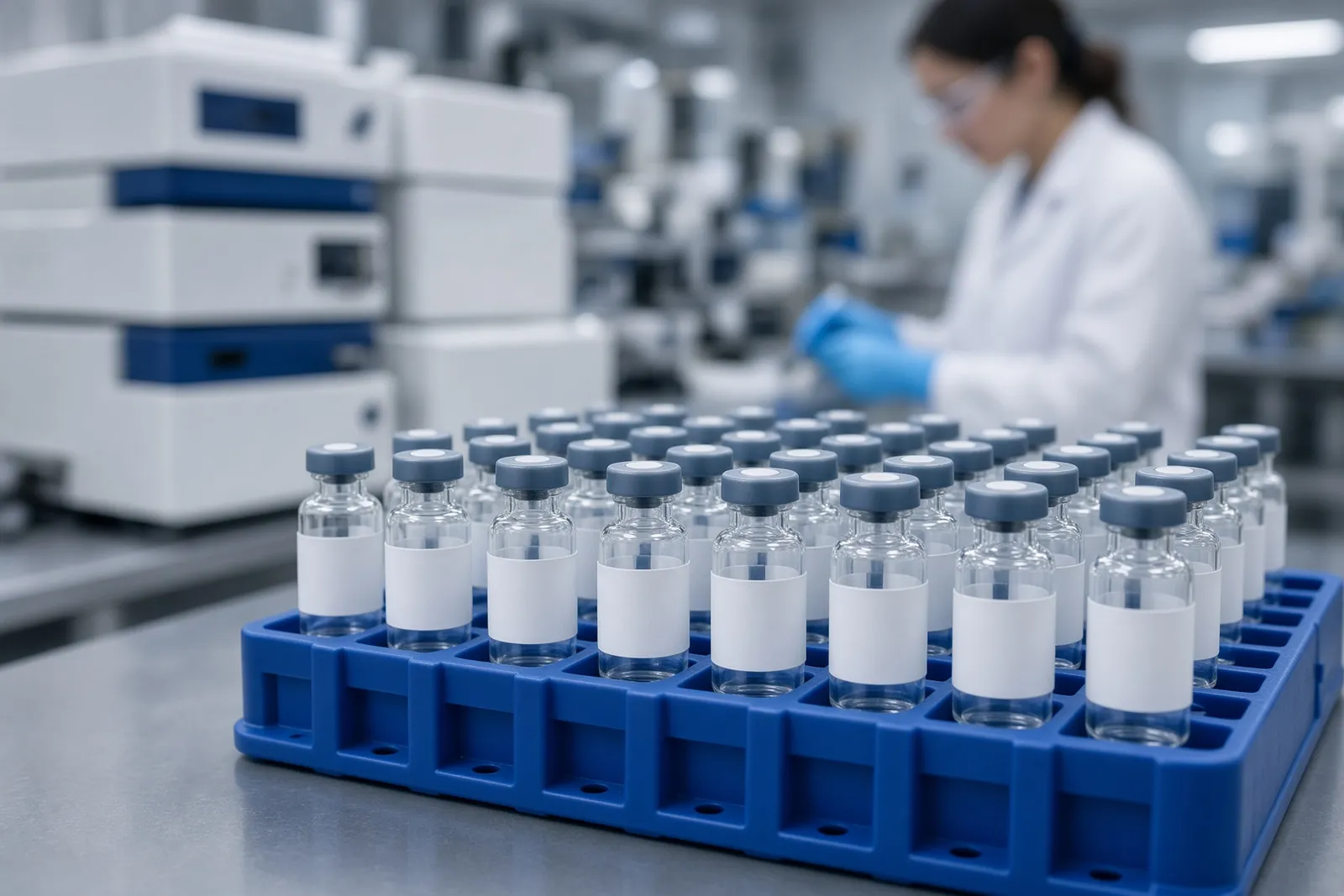
What the label is supposed to mean
A research use only product is meant for laboratory experiments, not for people. When a real laboratory buys a peptide for genuine research, that is a lawful use.[4] Universities, biotech companies and testing labs buy research peptides every day.
Why the label does not decide the law
The FDA judges a product by its intended use, not just by its label. Under federal rules (21 CFR 201.128), intended use is shown by everything around the product, including claims, website content and how it is sold.
FDA warning letters make this point again and again. In one, the agency noted that despite labels such as "research use only" and "not for human consumption," evidence from the seller's website showed the products were drugs intended for human use.[5]
What the FDA looked at in recent warning letters
On August 24, 2026, the FDA's drug center sent warning letters to five online peptide vendors. Every vendor used some form of research use only disclaimer, and the FDA rejected it in each case.[6]
Law firm reviews of these letters point to the same evidence the FDA relied on:[7]
- Dosing guides and "peptide calculators" that suggest use by injection.
- Bacteriostatic water sold alongside the peptides, which the FDA treated as a drug product.
- Health claims and marketing on the website that point to human use.
The letters also targeted peptides such as tesamorelin and ipamorelin, showing that enforcement now reaches well beyond GLP-1 copies.[8]
When research use only crosses into fraud
The most serious cases involve criminal charges. In one recent federal case, a company CEO faced a felony conviction and a long prison sentence for selling peptides as research use only while knowing they were for human use. The company also forged certificates of analysis to vouch for product quality.[34]
That case shows why a certificate of analysis is only useful if it is real. On SN Peptide, each brand page summarizes the test information a vendor publishes and how you can check it, so you can compare what peptide vendors publish about testing side by side.
Were Peptides "Unbanned"? The 2023 to 2026 Timeline
The word "unbanned" covers several separate steps. None of them approved a peptide as a drug.[9]
| Date | What happened |
|---|---|
| 2023 | The FDA placed popular peptides, including BPC-157, in Category 2, citing immune reactions, impurities and limited safety data.[10] |
| February 27, 2026 | HHS Secretary Robert F. Kennedy Jr. said about 14 of the 19 restricted peptides would move back to Category 1.[11] |
| April 15, 2026 | The FDA announced it would remove 12 peptides from Category 2 and scheduled advisory committee meetings.[12] |
| July 23 and 24, 2026 | The Pharmacy Compounding Advisory Committee recommended six of the seven nominated peptides for the compounding list. The seventh, emideltide (DSIP), was not recommended.[13][35] |
| August 24, 2026 | The FDA sent five warning letters to online research use only peptide vendors.[6] |
| October 30, 2026 | HHS published an interim enforcement discretion policy for compounding the six recommended peptides.[14] |
The science did not change
The votes went against the FDA's own reviewers. The FDA's drug center recommended against listing all six peptides, citing insufficient evidence of safety and effectiveness.[15] For four of the seven nominated peptides, the FDA found no human clinical studies for the proposed uses.[16]
As one pharmacist put it, a change in category does not prove a peptide works. It only restores a regulated route to access it.[9]
What the October 2026 HHS Policy Actually Allows

Who it covers
Under the interim policy, HHS does not intend to take enforcement action against state licensed pharmacies, federal facilities or licensed physicians that compound with six peptides: BPC-157, Epitalon, KPV, MOTS-c, Semax and TB-500.[17] The policy applies while the FDA works on formal rules for its compounding list.[18]
The main conditions
- It covers patient specific compounding under Section 503A, which requires a prescription. It does not cover 503B outsourcing facilities.[15]
- Each peptide is limited to specific dosage forms.[15]
- Each product may contain only one active ingredient. A blended BPC-157 and TB-500 vial would not qualify.[15]
What the policy does not do
- It does not legalize or approve the peptides. Legal analysts stress that enforcement discretion is not legalization.[19]
- It does not cover research use only sellers. HHS stated that one goal is to steer patients away from research use only peptides made by foreign manufacturers.[19]
- It does not override the states. State pharmacy boards can add their own restrictions or decline to recognize the policy.[17]
The public comment period closed on November 13, 2026, so details may still change.[15]
Is It Legal to Buy Peptides Online as an Individual?
This is the question most readers really want answered. The honest answer has three parts.
Sellers carry most of the legal risk
Federal enforcement has focused on companies that sell unapproved peptides for human use. Warning letters, injunctions and criminal cases have targeted vendors, not individual customers.
Importing is a separate issue
Under current federal law, importing unapproved new drugs is generally prohibited.[20] The FDA's personal importation policy allows some exceptions case by case, but one of its criteria is that no effective treatment is available in the United States.[21] Most peptides ordered from overseas do not meet that test, so shipments can be held or refused.
Peptides are not controlled substances, but that is not the same as legal
The peptides commonly discussed in wellness, such as BPC-157 and semaglutide, are not on any DEA controlled substance schedule.[22] That means they are regulated by the FDA as drugs rather than by drug enforcement law. It does not make an unapproved drug lawful to sell or market for human use.
Legal risk is not the only risk
Products outside regulated channels have no guaranteed contents. When Australia's TGA tested one product labeled as containing BPC-157 and TB-500, it detected no TB-500 at all.[23] In November 2026, Health Canada reported bacteria in an injectable peptide product seized from a retailer.[24]
Peptide Laws Outside the US
Many countries are stricter than the United States. A research use only label does not change the rules in any of them.
Australia
Australia's medicines regulator, the TGA, states that "research use only" or "not for human use" disclaimers do not change whether a product is regulated as a therapeutic good.[25] In New South Wales, possessing or trying to possess these peptides without a valid prescription is a criminal offence, with a maximum penalty of a $2,200 fine, six months in prison, or both.[26]
Canada
Health Canada treats injectable peptides as prescription drugs that must be authorized before they can be sold.[27] On June 11, 2026, a Québec court granted Health Canada a permanent injunction that stops one online retailer from selling unauthorized injectable peptides.[28]
United Kingdom
Under the Human Medicines Regulations 2012, a medicine must hold a marketing authorisation from the MHRA before it can be placed on the UK market.[29] The MHRA decides case by case whether a product counts as a medicine.[30] The National Pharmacy Association has called for an urgent review of research only sales, warning that they allow unregulated peptides to be sold openly online.[31]
Peptides and Sport: Legal Is Not the Same as Permitted

Athletes face a separate set of rules. BPC-157 is prohibited under the World Anti-Doping Agency (WADA) Prohibited List, in the category S0 Non-Approved Substances.[32]
S0 works as a catch all. It bans any pharmacological substance that no government health authority has approved for human therapeutic use.[33] This means the 2026 US compounding policy does not change anything for athletes. A peptide can be compounded legally and still lead to a doping violation.
How to Check the Legal Status of Any Peptide
Use these five checks before you trust any claim that a peptide is "legal."
- Is it an approved drug? Search the FDA's drug database (or your national regulator's) for the exact peptide name.
- Which FDA category is it in? Check the FDA's 503A bulk drug substances page for Category 1, 2 or 3 status.
- Is it covered by the 2026 HHS policy? Only six peptides are, and only through licensed pharmacies with a prescription.
- What do your state or country rules say? State pharmacy boards and foreign regulators can be stricter than federal policy.
- Do you compete in sport? Check the current WADA Prohibited List or ask your national doping control agency.
If you are comparing vendors, also look at what each one publishes about testing. SN Peptide organizes vendor published details such as purity, test methods and certificates of analysis so you can compare peptide vendors and equivalent listings fairly. We do not make, stock or sell any product.
The Bottom Line
Peptides are not legal or illegal as a group. The answer depends on the peptide, the channel, who you are and where you live.
The 2026 changes opened one narrow door: prescription compounding of six peptides through licensed pharmacies. They did not approve those peptides as drugs, and they did not change the rules for research use only products sold for human use.
Laws in this area are moving fast, so check the date on any source you rely on. For side by side vendor information, see the peptide vendor directory on SN Peptide.
Frequently Asked Questions
Is BPC-157 legal now?
BPC-157 is still not an FDA approved drug. Since October 2026, an interim HHS policy says federal regulators do not intend to act against licensed pharmacies and physicians that compound it for individual patients with a prescription, under specific conditions. That policy does not cover research use only products, and BPC-157 remains prohibited in sport.
Is it illegal to buy research peptides?
Buying a peptide for genuine laboratory research is a recognized legal use. Selling research use only peptides for human use is not. The FDA has repeatedly ruled that a research use only label does not protect a seller when the marketing shows the product is meant for people. Rules for individual buyers vary by country, and some countries, such as Australia, treat possession without a prescription as an offence.
Are peptides controlled substances?
In the United States, the peptides commonly discussed in wellness, such as BPC-157 and semaglutide, are not listed on DEA controlled substance schedules. They are regulated by the FDA as drugs instead. Not being controlled does not make an unapproved drug legal to sell.
Can my doctor prescribe compounded peptides?
A licensed doctor can prescribe FDA approved peptides and, in some cases, compounded peptides from a state licensed pharmacy. For BPC-157, TB-500, KPV, MOTS-c, Semax and Epitalon, the interim HHS policy sets extra conditions, and state pharmacy boards can still restrict access.
Did the FDA unban peptides in 2026?
Partly. In 2026 the FDA removed 12 peptides from its Category 2 list, an advisory committee backed six of them for compounding, and HHS announced it would not enforce against compounding those six under set conditions. None of these steps approved the peptides as drugs or legalized research use only sales for human use.
Are peptides legal in Australia, the UK and Canada?
Approved peptide medicines are legal with a prescription in all three countries. Unapproved peptides face strict rules. Australia treats many as prescription only and possession without a prescription can be an offence. Canada regulates injectable peptides as prescription drugs that must be authorized. The UK requires a marketing authorisation from the MHRA before a medicine can be sold.
References
- DJ Holt Law. What peptides are legal in the U.S.? Understanding FDA approval, compounding and the legal gray areas.
- BSCG. What's changing with peptide regulation in 2026.
- Orrick. FDA announces removal of 12 peptides from Category 2 and schedules PCAC meetings. April 2026.
- PeptideJournal. Are peptides legal? State by state guide (2026).
- U.S. Food and Drug Administration. Warning letter to USApeptide.com, February 26, 2025. fda.gov
- ArentFox Schiff. Five peptide vendors learn that research use only is not a legal strategy. 2026.
- Sheppard Mullin. FDA balances peptide policy with enforcement against unlawful peptide sellers. 2026.
- McDermott Will & Schulte. Federal regulators and state boards crack down on RUO peptides. 2026.
- Pharmacy Times. The peptide reclassification everyone is talking about: a pharmacist's take. June 4, 2026.
- McMaster University. Analysis: The peptide problem: hype is outrunning the evidence. 2026. news.mcmaster.ca
- AJMC. 5 things to know about the FDA's peptide reversal. August 21, 2026.
- Goodwin. FDA signals potentially evolving stance toward compounding of certain peptides. May 11, 2026.
- Buchanan Ingersoll & Rooney. Compounding peptides: what pharmacies need to know about the HHS interim enforcement discretion policy for six peptides. 2026.
- Federal Register. Enforcement discretion policy regarding 503A compounding using certain peptide bulk drug substances. October 30, 2026. federalregister.gov
- The Garden Island (Stacker). Are peptides legal now? What the new HHS policy really means. November 16, 2026.
- Health Affairs Forefront. FDA advisory committee's vote may open a drug compounding back door for unapproved peptides. 2026. healthaffairs.org
- Akin Gump. HHS announces interim enforcement discretion policy for compounding six peptides. November 10, 2026.
- Becker's Hospital Review. HHS allows compounding of 6 unapproved peptides. 2026.
- Venable. HHS announces interim enforcement discretion for Section 503A compounding with certain peptide bulk drug substances. November 2026.
- Congressional Research Service. Prescription drug importation (IF11056). 2026.
- Congressional Research Service. Prescription drug importation (IF11056). 2022.
- PeptideJournal. DEA classification of peptides: current status. 2026.
- Therapeutic Goods Administration. Laboratory testing of peptide products. tga.gov.au
- American Med Spa Association. Health Canada warns against unauthorized peptides after bacteria found in seized products. November 19, 2026.
- Therapeutic Goods Administration. Unapproved peptide products. tga.gov.au
- Law Society Journal. Injectable peptides: where does the law stand?
- Gowling WLG. Peptides in Canada: regulatory reality is catching up with the hype. 2026.
- Health Canada. Health Canada obtains permanent injunction preventing Canlab Research's illegal sale of injectable peptides in Canada. July 29, 2026. canada.ca
- Consulting Room. Peptides, wellness and the law.
- The Guardian (via inkl). Medicines watchdog to investigate UK peptide clinics over health claims. 2026.
- STV News. The peptide boom: legal loophole fuels rise of unregulated injectables. 2026.
- USADA. BPC-157: what athletes should know about the prohibited experimental peptide. usada.org
- German Sport University Cologne. S0 Non approved substances. dshs-koeln.de
- McDermott Will & Schulte. Client alert on RUO peptide enforcement and the related federal criminal case. 2026.
- Foley & Lardner. Peptides: HHS announces limited enforcement discretion for compounding of six peptides. October 2026.

Jason White
Founder and web developer
Jason White is a web developer who enjoys affiliate marketing, hunting for good deals and building web products that are genuinely useful. He created SN Peptide to put peptide vendors, prices, coupon codes and research information in one clear place, so people can compare their options quickly instead of opening dozens of shop pages.
Jason is not a doctor or a scientist. For that reason, the research summaries on SN Peptide are built on cited, peer-reviewed sources and never include medical advice or instructions for use.