Acetyl Hexapeptide Peptide
Also known as Acetyl hexapeptide-8, Acetyl hexapeptide-3, Argireline, Ac-EEMQRR-NH2
Acetyl Hexapeptide Peptide explained: what research says about benefits and side effects, plus prices from 1 vendor and current coupon codes.
- 1vendor
- $95.00lowest price (1 g)
- 20% offbest code at Certified-Pep
For research and informational purposes only. Not medical advice. SN Peptide does not sell peptides.
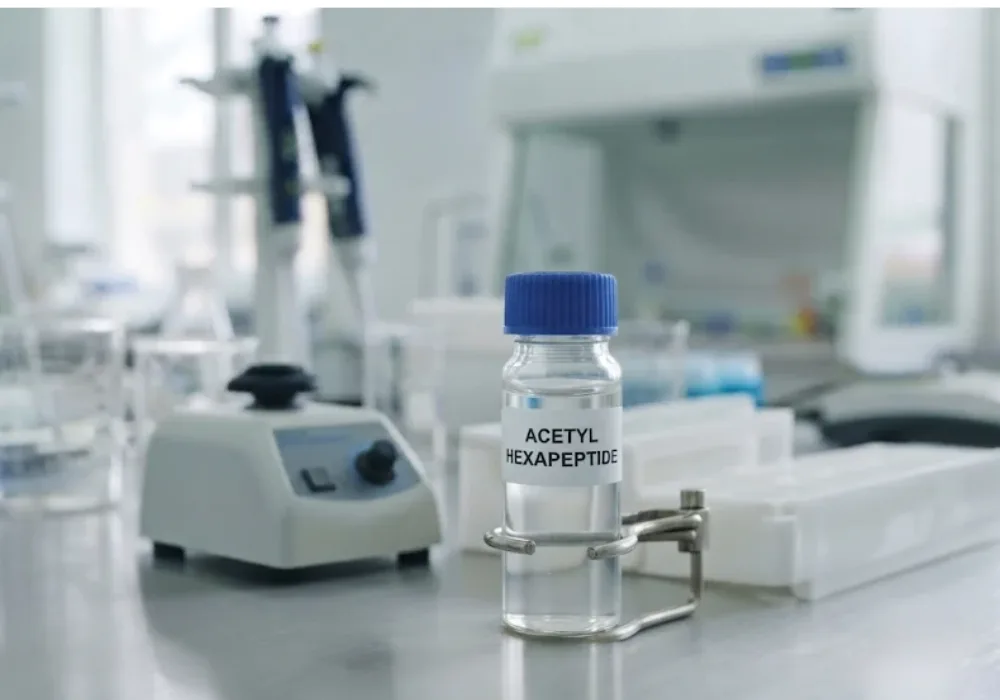
What Is the Acetyl Hexapeptide Peptide?
Acetyl Hexapeptide is a short synthetic peptide of six amino acids (glutamic acid, glutamic acid, methionine, glutamine, arginine, arginine), acetylated at one end and amidated at the other, written Ac-EEMQRR-NH2. It is best known under the trade name Argireline and as the cosmetic ingredient acetyl hexapeptide-8, a name that replaced the earlier INCI listing acetyl hexapeptide-3. In practice, it is one of the most widely used peptides in anti-aging skin care.
The peptide was not discovered by chance; instead, it came out of a rational design programme. In 2002, a team led by Antonio Ferrer-Montiel at Miguel Hernández University in Alicante, Spain, described it in the International Journal of Cosmetic Science. They modeled it on the N-terminal end of SNAP-25, one of the proteins that make up the SNARE complex, the molecular machinery nerve cells use to release neurotransmitters. By competing with SNAP-25, the hexapeptide interferes with the formation of this complex and, in laboratory tests, reduced neurotransmitter release.
This mechanism explains why acetyl hexapeptide is often marketed as a "botox-like" peptide. However, the comparison has clear limits. In the same 2002 study, the hexapeptide showed a potency similar to botulinum toxin type A in cell experiments, yet a much lower efficacy. Furthermore, a 2025 review in the International Journal of Molecular Sciences concluded that acetyl hexapeptide-8 is hydrophilic and relatively large, so it penetrates the outer skin layer (stratum corneum) poorly, and whether it reaches the nerve and muscle junctions at all remains uncertain.
From a regulatory point of view, acetyl hexapeptide is a cosmetic ingredient, not a medicine. It has never been approved as a drug by the U.S. Food and Drug Administration (FDA) or the European Medicines Agency (EMA), and cosmetic products that contain it are not evaluated for effectiveness before sale. It belongs to the same family of biomimetic cosmetic peptides as its longer analog SNAP-8 (acetyl octapeptide-3) and the copper peptide GHK-Cu.
Research vendors sell acetyl hexapeptide as a raw peptide powder rather than a finished skin-care product. Consequently, the listings on SN Peptide are research materials, and their prices are not comparable with creams or serums that contain the peptide in small amounts.
Best prices & deals
Where to Buy Acetyl Hexapeptide Peptide Online
- $76.00
$95.00with code LENA (20% off)USD · checked Nov 18, 2026Visit vendor(opens in a new tab)Code verified Nov 12, 2026
Acetyl Hexapeptide Benefits: What Research Shows
The points below summarize effects that have been studied in research. Each one shows the type of evidence behind it, because findings from animal or laboratory studies do not prove that the same effects occur in people.
- Wrinkle depth: in the original 2002 study, an oil-in-water emulsion containing the hexapeptide reduced wrinkle depth by up to 30% after 30 days in healthy women volunteers, measured by skin topography.Limited human data
- Periorbital wrinkles: a 2013 randomized, placebo-controlled study in 60 Chinese subjects found a 48.9% overall anti-wrinkle efficacy around the eyes after four weeks, compared with 0% for placebo, and lower skin roughness on silicone replicas.Clinical
- Neurotransmitter release: in cell experiments, acetyl hexapeptide interfered with the SNARE complex and significantly reduced calcium-dependent neurotransmitter release.Preclinical
- Elasticity and hydration: according to a 2025 review, some preclinical and clinical studies also reported better skin elasticity and hydration, and a few explored scar remodeling and sebum regulation, although these findings are less consistent.Limited human data
Evidence levels: Preclinical (animal or lab studies) · Clinical (human studies) · Limited human data.
Acetyl Hexapeptide Peptide Side Effects and Safety
- Low irritation in early testing: the 2002 study reported no primary skin irritation and no oral toxicity in its safety tests, even at high amounts.
- Well tolerated in a short trial: the 2013 randomized study evaluated safety alongside efficacy over four weeks of topical use around the eyes.
- Limited long-term data: published studies are small and short, so long-term effects of regular use have not been established.
- Not equivalent to botulinum toxin: because skin penetration is low and its effect is much weaker, acetyl hexapeptide should not be expected to work like an injectable neurotoxin.
- Raw research powders are not cosmetics: the safety findings above come from finished cosmetic formulations. Raw peptide sold by research vendors is not a consumer product, so check the vendor's certificate of analysis (COA), which is vendor-provided unless marked otherwise.
Acetyl Hexapeptide Dosage: What Research Says
The human evidence for acetyl hexapeptide comes only from cosmetic creams and emulsions applied to the skin in short studies, never from raw peptide powder.
Since no medical dose exists and delivery through the skin is itself the main open question, SN Peptide gives no amounts, concentrations or instructions for use.
Acetyl Hexapeptide Peptide FAQs
Is acetyl hexapeptide the same as Argireline?
Yes. Argireline is the trade name of the hexapeptide Ac-EEMQRR-NH2, listed as the cosmetic ingredient acetyl hexapeptide-8 (formerly acetyl hexapeptide-3).
Is acetyl hexapeptide a topical botox?
No. It was designed to mimic part of how botulinum toxin works by interfering with the SNARE complex, but in laboratory tests its effect was much weaker, and reviews note that it penetrates the skin poorly. It is a cosmetic ingredient, not an alternative to an injectable medicine.
Does acetyl hexapeptide reduce wrinkles?
Small studies suggest it can: a 2002 study reported up to 30% lower wrinkle depth after 30 days, and a 2013 placebo-controlled study found improvements in wrinkles around the eyes after four weeks. Larger and longer studies are still lacking.
What is the difference between acetyl hexapeptide and SNAP-8?
SNAP-8 (acetyl octapeptide-3) is a longer, eight amino acid version built on the same SNAP-25 sequence. Both are cosmetic peptides studied for expression wrinkles.
Is acetyl hexapeptide FDA approved?
No. It is a cosmetic ingredient and has never been approved as a drug. Cosmetic products containing it are not reviewed for effectiveness before sale.
Where can I buy acetyl hexapeptide online?
Only a few research peptide vendors sell acetyl hexapeptide, usually as raw powder. On this page, SN Peptide lists the vendors that carry it with their current prices, the date each price was last checked and any exclusive coupon code.
References
- Blanes-Mira C, Clemente J, Jodas G, et al. A synthetic hexapeptide (Argireline) with antiwrinkle activity. International Journal of Cosmetic Science. 2002;24(5):303-310.
- Wang Y, Wang M, Xiao S, et al. The anti-wrinkle efficacy of argireline, a synthetic hexapeptide, in Chinese subjects: a randomized, placebo-controlled study. American Journal of Clinical Dermatology. 2013;14(2):147-153.
- Zdrada-Nowak J, Surgiel-Gemza A, Szatkowska M. Acetyl Hexapeptide-8 in Cosmeceuticals: A Review of Skin Permeability and Efficacy. International Journal of Molecular Sciences. 2025;26(12):5722.
Last reviewed Nov 21, 2026.